You cannot be sovereign in the digital age if the chips inside your infrastructure belong to someone else.
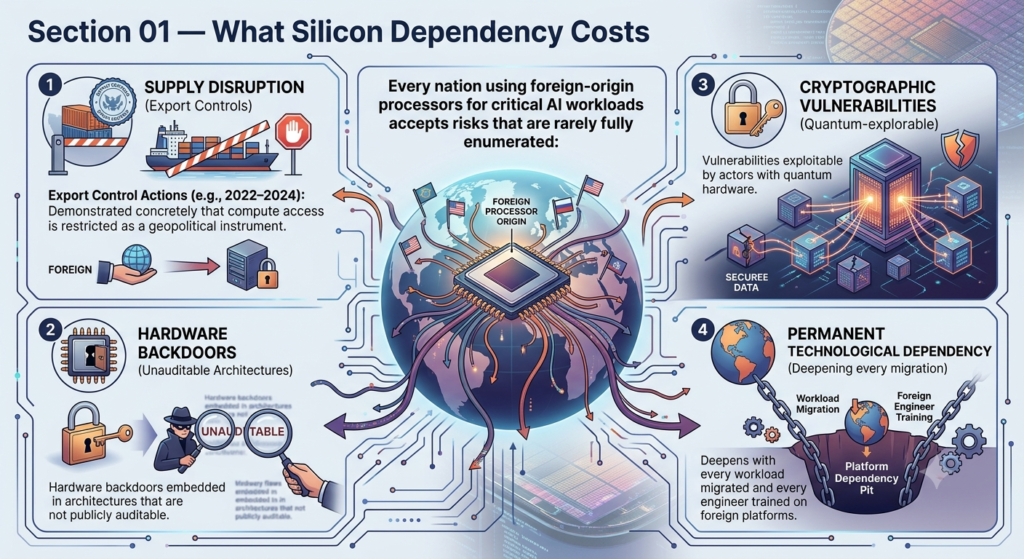
Every nation that runs its critical AI workloads on foreign-origin processors has accepted a set of risks that are rarely fully enumerated: the risk of supply disruption through export controls, the risk of hardware backdoors embedded in architectures that are not publicly auditable, the risk of cryptographic vulnerabilities exploitable by actors with access to quantum hardware, and the risk of permanent technological dependency that deepens with every workload migrated and every engineer trained on foreign platforms.
These are not theoretical risks. Export control actions in 2022–2024 demonstrated concretely that access to advanced compute can be restricted as a geopolitical instrument.
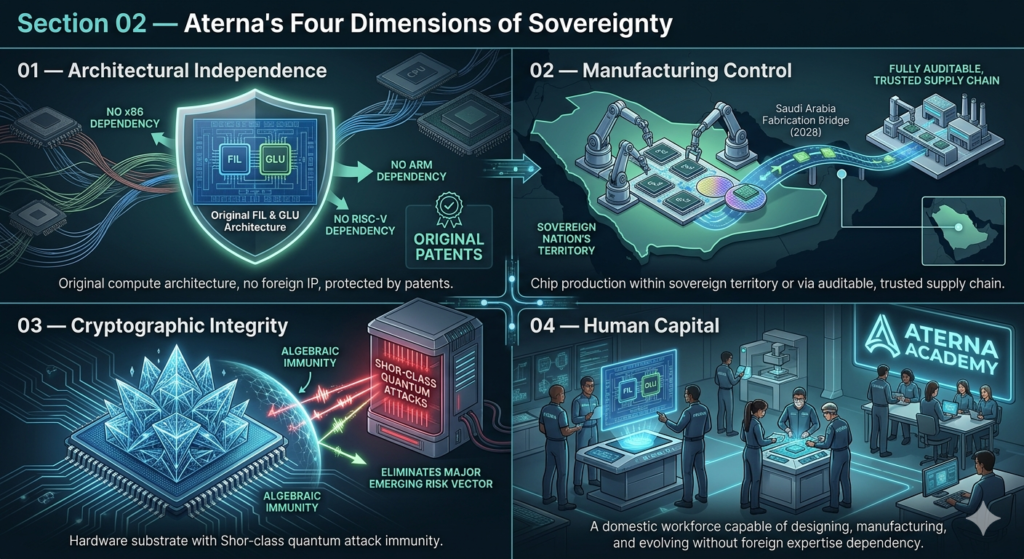
A compute architecture that is not derived from, licensed from, or compatible with foreign IP. FIL and GLU are original Aterna architectures, protected by original patents, with no inherited x86, ARM, or RISC-V dependency
The ability to produce the chip within the sovereign nation’s territory or within a fully auditable, trusted supply chain. The Saudi Arabia Fabrication Bridge (2028) delivers this.
A hardware substrate whose algebraic structure is immune to Shor-class quantum attacks, eliminating the most significant emerging cryptographic risk vector.
A domestic workforce capable of designing, manufacturing, and evolving the architecture without foreign expertise dependency. The Aterna Academy is how we build this.

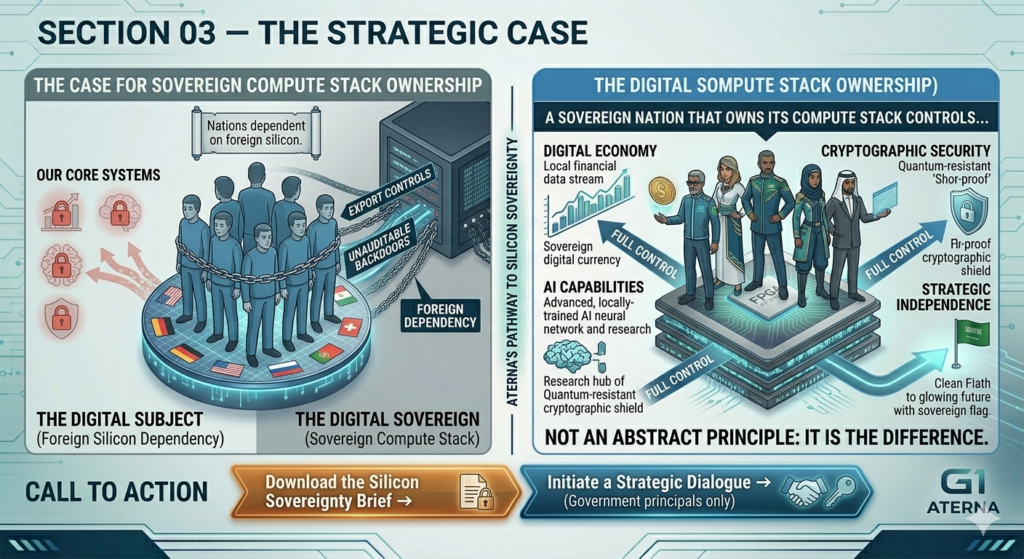
A sovereign nation that owns its compute stack controls its digital economy, its AI capabilities, its cryptographic security, and its strategic independence in ways that nations dependent on foreign silicon cannot. This is not an abstract principle. It is the difference between being a digital subject and a digital sovereign.
Fill out the form to request the document