Energy Efficiency Research — 96% Power Reduction. Validated.

The AI energy crisis has a mathematics problem. We solved the mathematics.

The Scale of the Problem

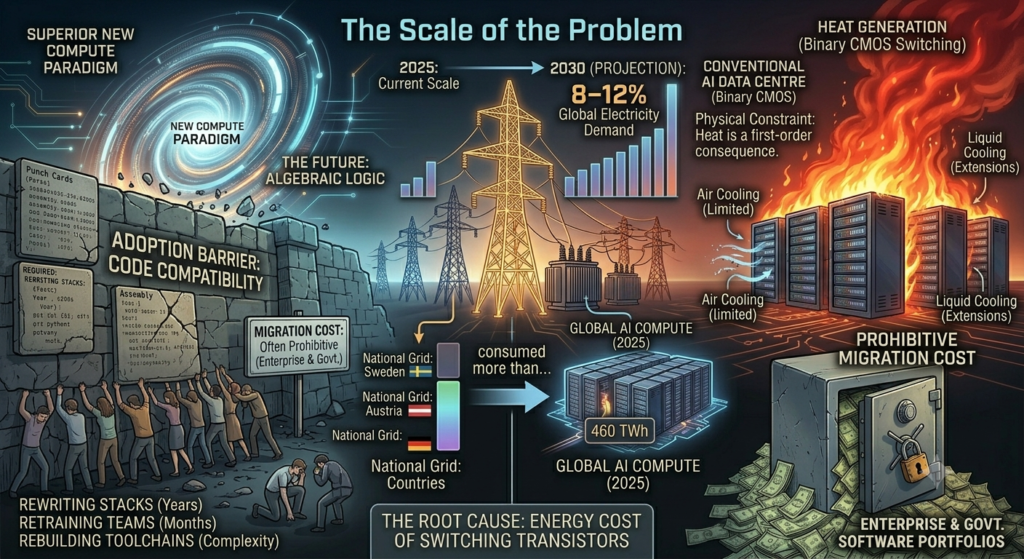
Global AI compute consumed an estimated 460 terawatt-hours of electricity in 2025 — more than the entire national grid consumption of several mid-sized countries. By 2030, on current trajectories, AI data centres are projected to account for 8–12% of global electricity demand. The constraint is no longer algorithmic or architectural. It is physical: binary CMOS switching generates heat as a first-order consequence of its operating principle, and that heat must be removed.

Air cooling is hitting its limits. Liquid cooling extends the runway. Neither addresses the root cause.

Why Binary Chips Run Hot

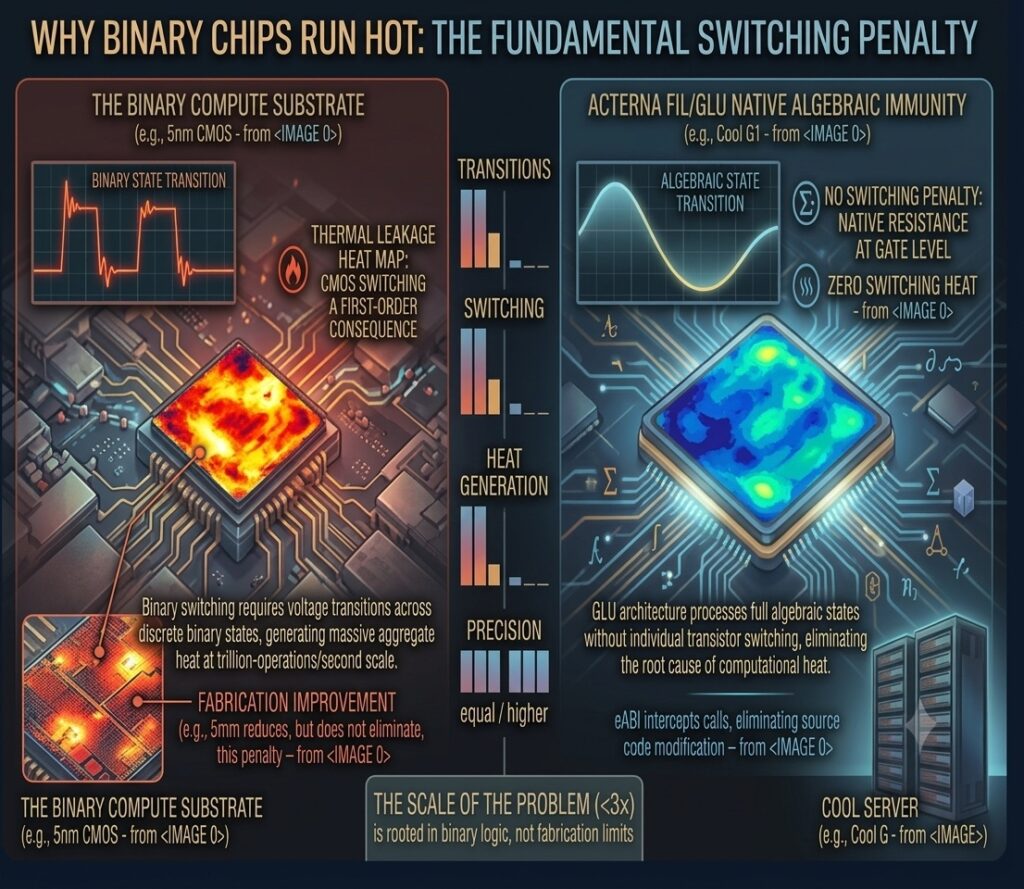
A CMOS transistor generates heat every time it switches — every time it moves from 0 to 1 or back. In a modern AI accelerator performing trillions of such switches per second, the aggregate thermal output is enormous. This is not a manufacturing defect or a design flaw. It is a consequence of encoding computation as voltage transitions across discrete binary states.

No amount of fabrication process improvement eliminates this. 2nm CMOS is more efficient than 5nm CMOS, but it is still switching binary states, and it is still generating heat.

Aterna's Measured Results

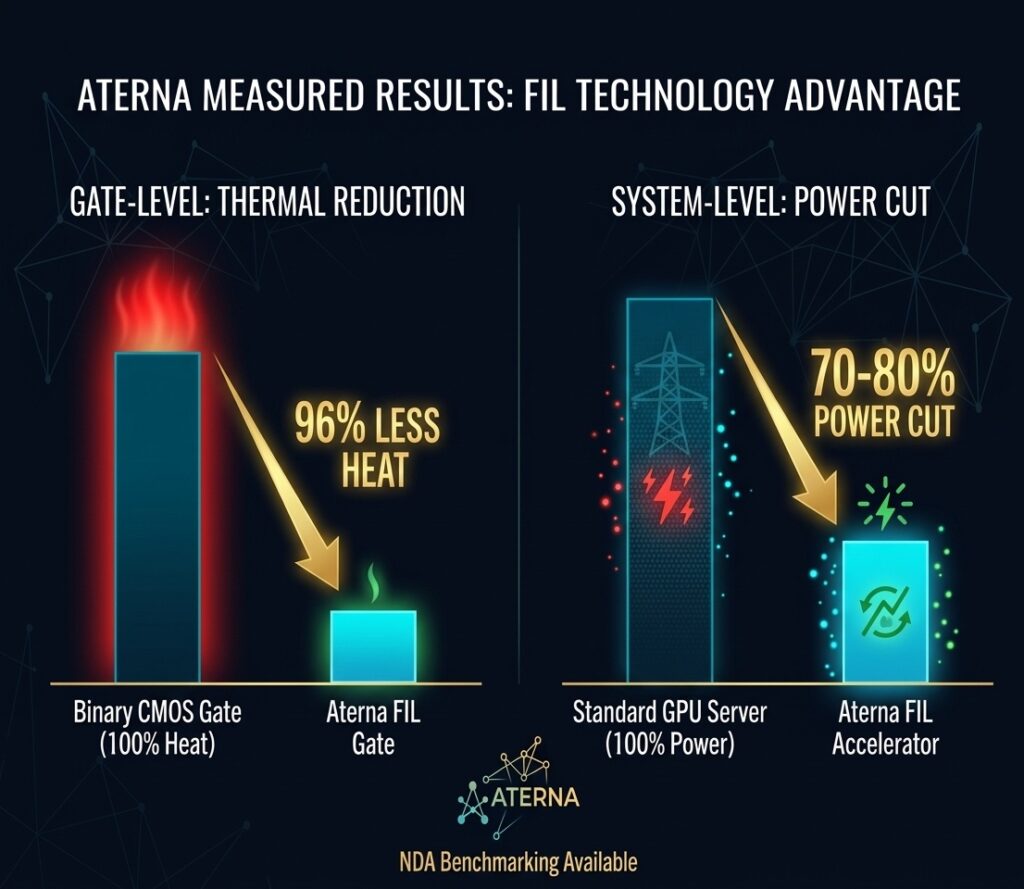
FIL gates operating through Lie-algebraic transitions generate 96% less heat than equivalent binary CMOS gates performing the same logical operations. This figure has been validated through:

  • FPGA emulation benchmarks on Xilinx Ultrascale+ hardware (2025)
  • RTL simulation with formal verification against binary gate equivalents
  • Independent power envelope measurement on G1 Alpha cards (Q1 2026)

The 96% figure represents gate-level thermal reduction. At system level, accounting for memory, I/O, and power supply overhead, net system-level power reduction for AI inference workloads is approximately 70–80% versus comparable binary GPU configurations. Full benchmark methodology and data are available under NDA to qualified technical partners.

National Energy Implications

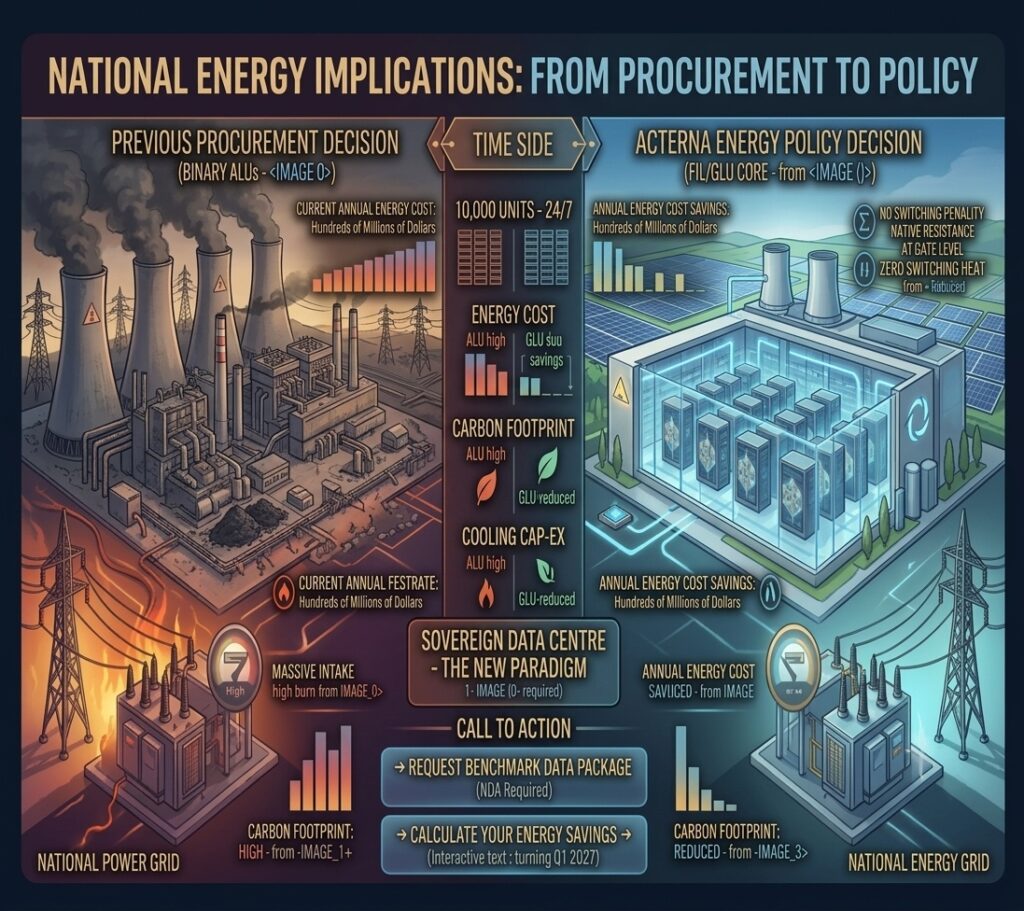
For a sovereign AI data centre running 10,000 accelerator units 24/7, a 70% power reduction translates to hundreds of millions of dollars in annual energy cost savings — and a proportional reduction in carbon footprint and cooling infrastructure capital expenditure. For nations building AI capacity at scale, Aterna hardware is not a procurement decision. It is an energy policy decision.

Aterna’s eABI (Extended Application Binary Interface) was designed to eliminate this barrier entirely.

...

Fill out the form to request the document