Energy & Infrastructure — Grid-Scale AI at the Speed of Physics.

The energy sector runs on data. That data now runs on AI. The AI has to run on something sovereign.

The Convergence

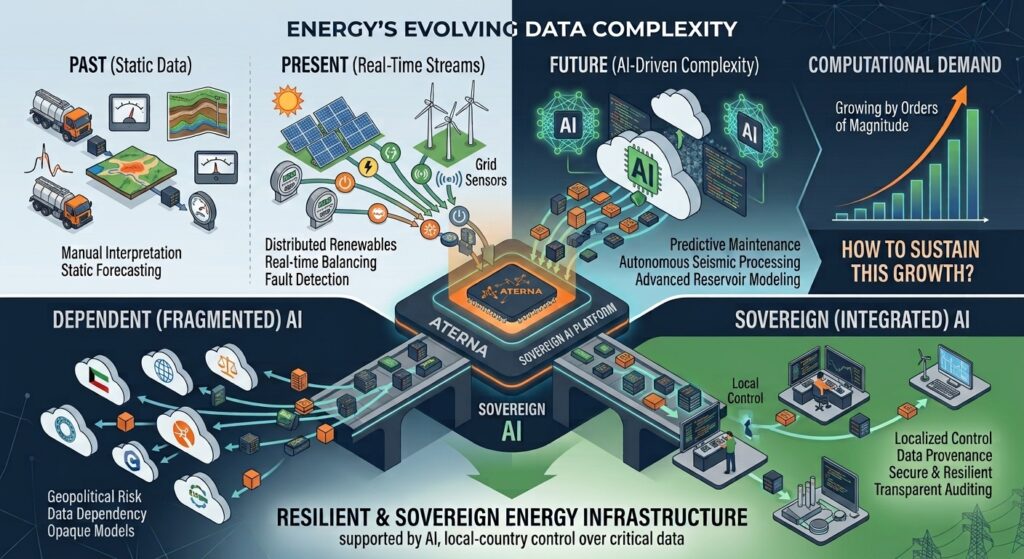
Energy infrastructure has always been data-intensive — seismic surveys, reservoir modelling, grid load forecasting, fault detection. But the complexity of that data has grown by orders of magnitude. AI models now manage real-time grid balancing across distributed renewable sources. Autonomous seismic processing replaces manual interpretation. Predictive maintenance algorithms monitor tens of thousands of distributed sensors simultaneously. The computational demand is immense — and growing.

The question is not whether energy infrastructure will run on AI. It already does. The question is whether the AI it runs on is sovereign.

Aterna's Role

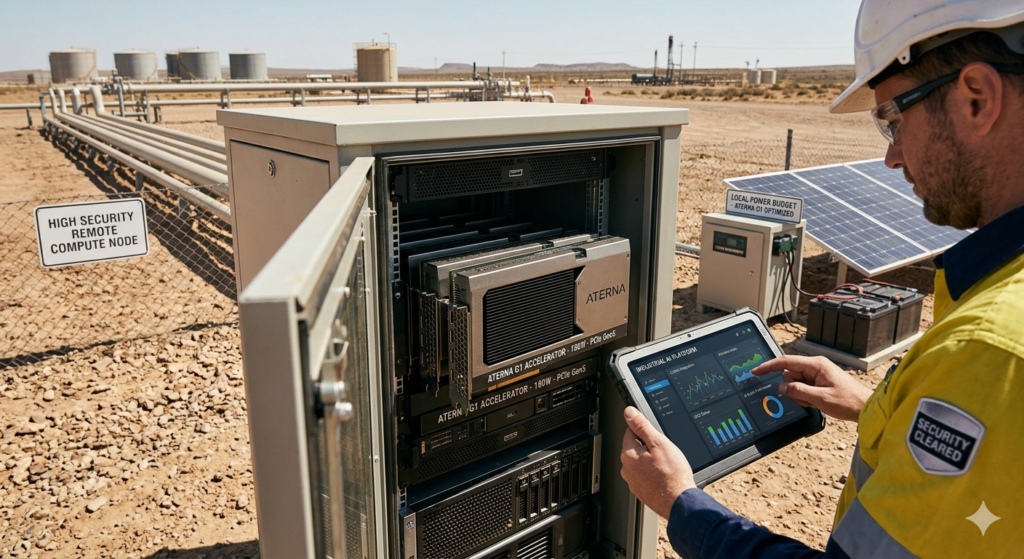
Aterna G1 accelerators are designed for deployment in harsh, remote, and high-security environments — the same conditions that define energy sector operations. The 180W power envelope, PCIe Gen5 interface, and native Python/C++ compatibility make integration with existing SCADA, DCS, and industrial AI platforms straightforward. The 96% power reduction versus binary GPU alternatives means that remote compute nodes can operate on local power budgets that binary accelerators cannot.

Use Cases

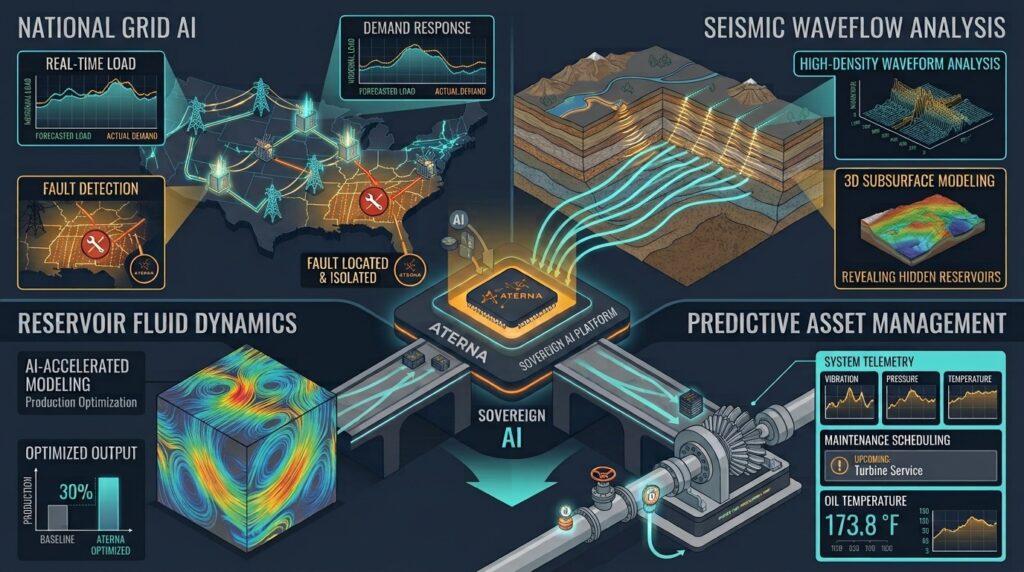
  • Real-time grid AI: Load forecasting, demand-response optimisation, and fault detection across national grids
  • Seismic processing: High-density waveform analysis and subsurface modelling
  • Reservoir simulation: AI-accelerated fluid dynamics modelling for production optimisation
  • Predictive maintenance: Continuous condition monitoring across distributed infrastructure assets

Air cooling is hitting its limits. Liquid cooling extends the runway. Neither addresses the root cause.

Sovereign Data Residency

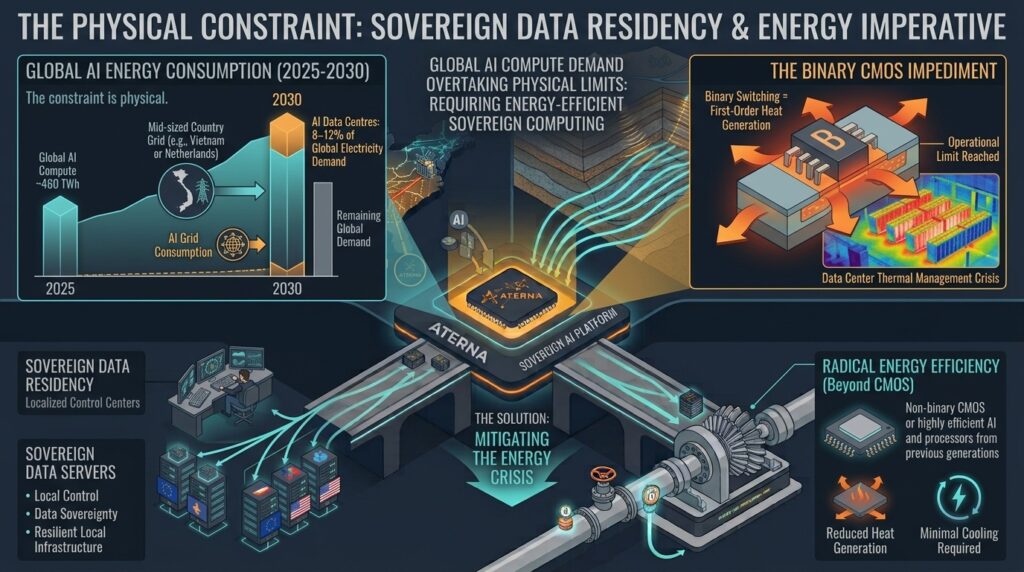
Global AI compute consumed an estimated 460 terawatt-hours of electricity in 2025 — more than the entire national grid consumption of several mid-sized countries. By 2030, on current trajectories, AI data centres are projected to account for 8–12% of global electricity demand. The constraint is no longer algorithmic or architectural. It is physical: binary CMOS switching generates heat as a first-order consequence of its operating principle, and that heat must be removed.

Air cooling is hitting its limits. Liquid cooling extends the runway. Neither addresses the root cause.

...

Fill out the form to request the document