FIL Framework — Fractal Information Logic.

Binary was a beginning. FIL is what comes next.

31 states. One cycle. The end of the binary bottleneck.

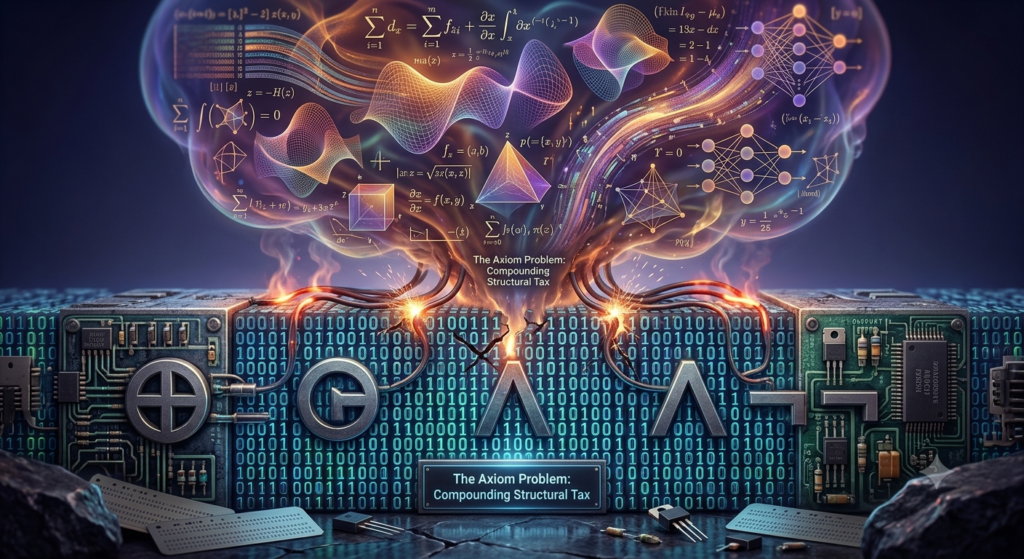
The Axiom Problem.

Binary logic — the 0/1 paradigm that underpins every CPU, GPU, and TPU ever manufactured — was not designed. It emerged. Claude Shannon’s 1948 information theory formalised it, and the semiconductor industry built an entire civilisation on top of it. The result is extraordinary: billions of transistors on a chip the size of a fingernail, connected by fabrication processes measured in angstroms.

But binary logic carries a structural tax. Every computation requires a series of Boolean operations — AND, OR, NOT — that collapse richer mathematical relationships into sequential chains of ones and zeros. As workloads grow in complexity, particularly AI inference and training, this tax compounds. More operations. More heat. More power. More space.

What FIL Is

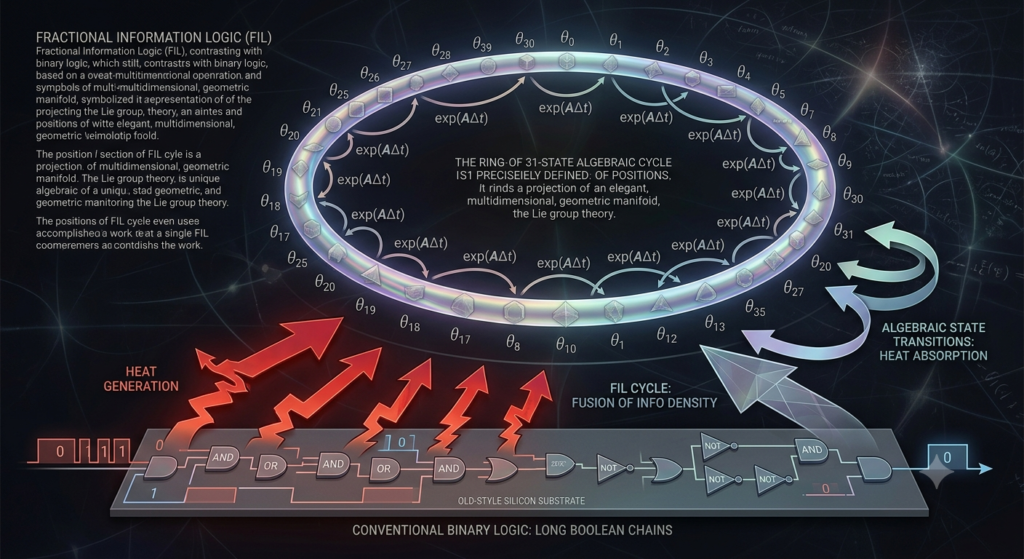
Fractal Information Logic (FIL) is an algebraic computation framework built on Lie group theory. Rather than encoding information as discrete binary states, FIL operates on a 31-state algebraic cycle — a closed mathematical structure in which each state is a precisely defined position within a Lie algebra, and transitions between states follow algebraic rather than Boolean rules.

The practical consequence is profound: a single FIL cycle carries the information density of multiple binary cycles. Operations that require long Boolean chains in binary are resolved in fewer, richer algebraic steps. Computational work that would generate heat in CMOS gates is absorbed into the algebraic structure of the logic itself.

What FIL Is Not

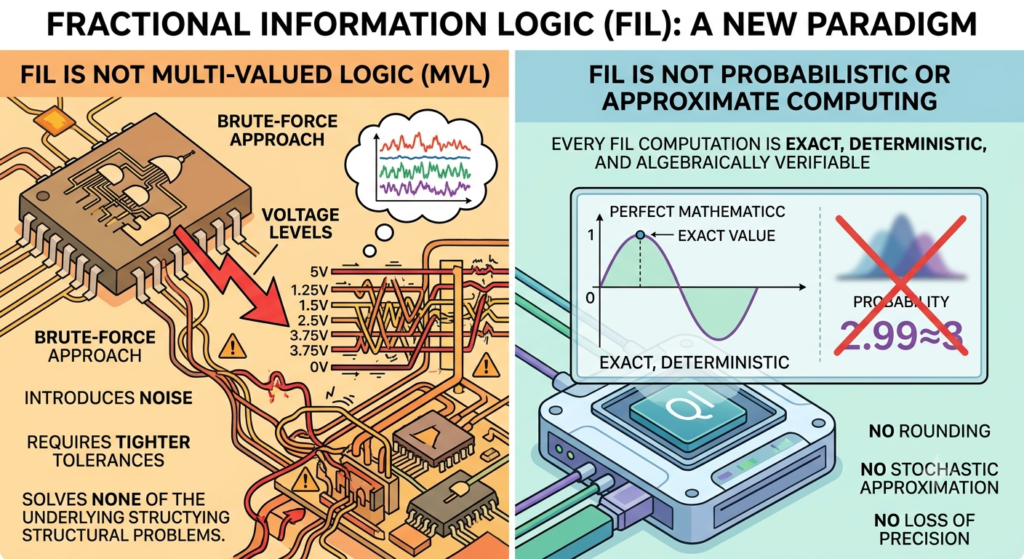
FIL is not multi-valued logic (MVL), a field with decades of academic history and limited commercial traction. MVL simply adds more voltage levels to binary gates — a brute-force approach that introduces noise, requires tighter fabrication tolerances, and solves none of the underlying structural problems.

FIL is not probabilistic or approximate computing. Every FIL computation is exact, deterministic, and algebraically verifiable. There is no rounding, no stochastic approximation, no loss of precision.

FIL is a new axiom. Not an extension of the old one.

Validated Claims

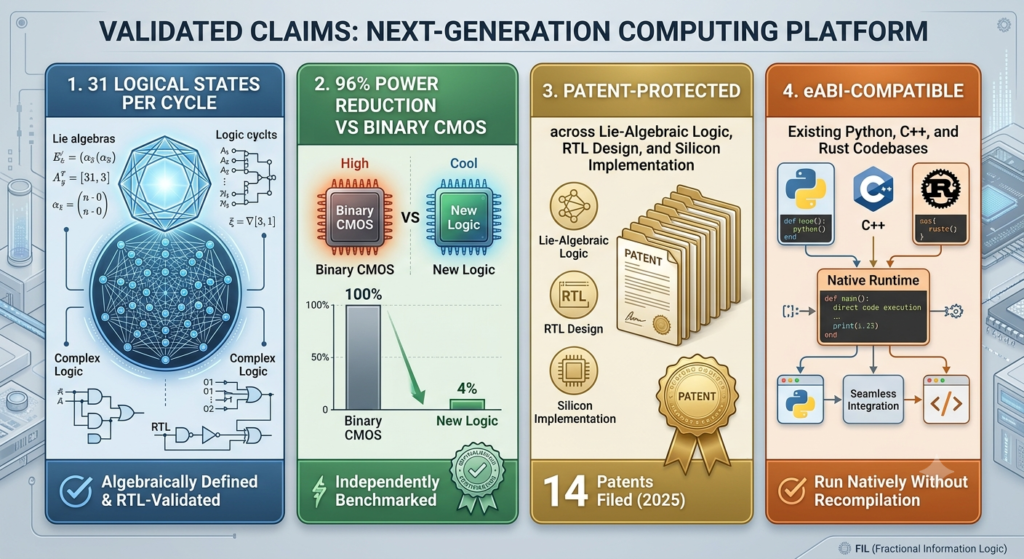
  • 31 logical states per cycle — algebraically defined and RTL-validated
  • 96% power reduction versus binary CMOS gate equivalents — independently benchmarked
  • Patent-protected across Lie-algebraic logic, RTL design, and silicon implementation (14 patents filed, 2025)
  • eABI-compatible — existing Python, C++ and Rust codebases run natively without recompilation

...

Fill out the form to request the document