Post-Quantum Resilience — Encryption Native to the Gate.

When quantum computers break RSA, FIL gates won’t notice.

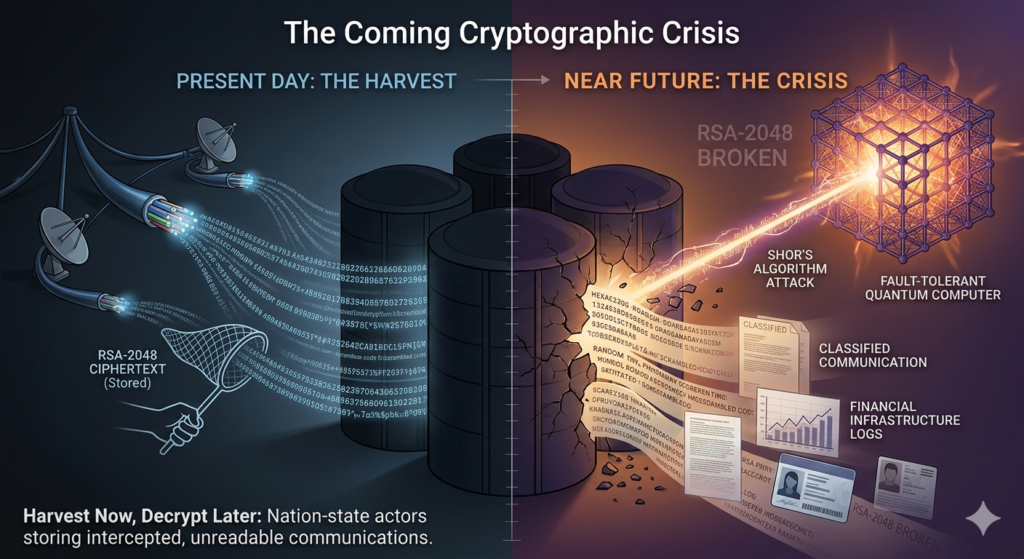
The Coming Cryptographic Crisis

The timeline is now concrete. NIST finalised its first post-quantum cryptographic standards in 2024. Nation-state actors are already harvesting encrypted data today under a strategy called ‘harvest now, decrypt later’ — storing intercepted ciphertext until sufficiently capable quantum hardware becomes available to break it.

RSA-2048, the encryption standard protecting the majority of the world’s sovereign communications, financial infrastructure, and classified data, is expected to fall to a Shor-algorithm attack on a fault-tolerant quantum computer within this decade. Every organisation that has not migrated its cryptographic stack is already compromised in slow motion.

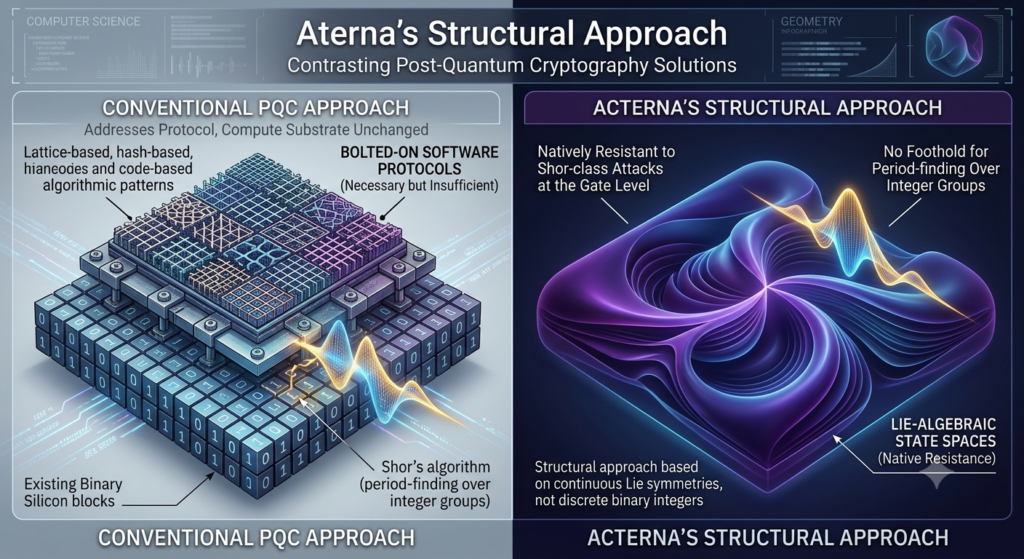
Aterna's Structural Approach

Conventional post-quantum cryptography (PQC) adds a software layer — lattice-based, hash-based, or code-based algorithms bolted onto existing binary silicon. This is necessary but insufficient. It addresses the protocol while leaving the underlying compute substrate unchanged.

Aterna’s approach is structural. Because FIL operates on Lie-algebraic state spaces rather than discrete binary integers, it is natively resistant to Shor-class attacks at the gate level. The mathematical objects that Shor’s algorithm exploits — period-finding over integer groups — have no foothold in an algebraic logic framework built on continuous Lie symmetries.

The result: post-quantum resilience is not a feature we add to our chips. It is a property that emerges from the mathematics.

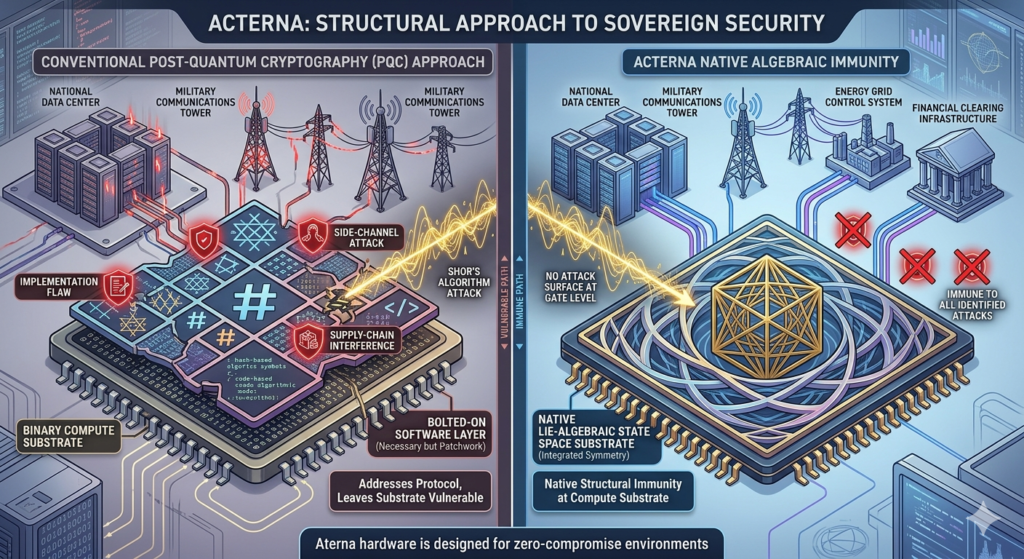
Implications for Sovereign Infrastructure

For national data centres, military communications networks, energy grid control systems, and financial clearing infrastructure, this distinction is existential. A software PQC layer can be compromised by implementation flaws, side-channel attacks, or supply-chain interference. A compute substrate whose algebraic structure is immune to Shor-class attacks at the gate level has no equivalent attack surface.

Aterna hardware is designed for environments where compromise is not an acceptable failure mode.

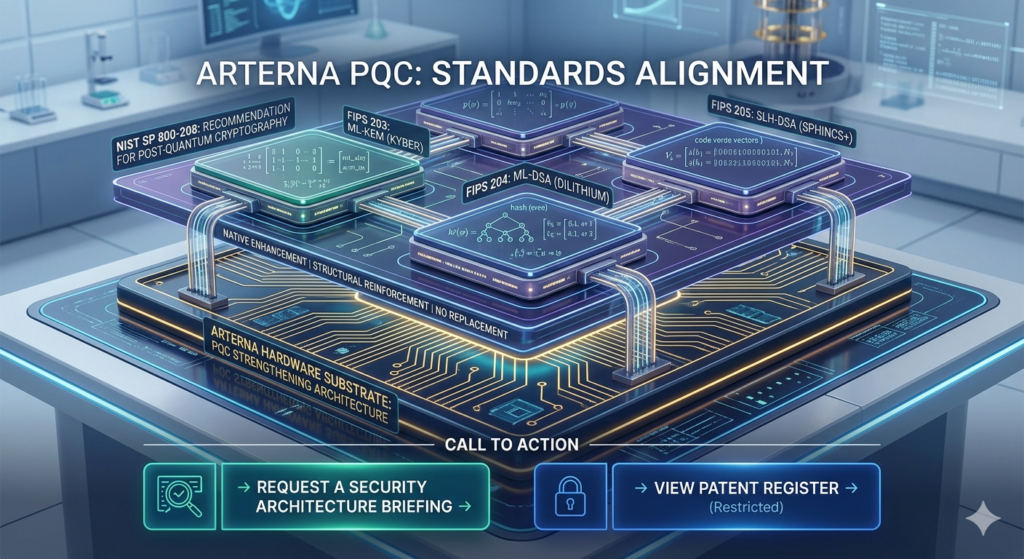
Standards Alignment

Aterna’s PQC posture is aligned with NIST SP 800-208 and FIPS 203/204/205 (ML-KEM, ML-DSA, SLH-DSA). Our architecture does not replace these standards — it provides a hardware substrate that makes them structurally stronger.

...

Fill out the form to request the document