eABI Interoperability — Change Your Hardware. Keep Your Code.

The most powerful new compute architecture in a generation — and your developers won’t need to learn anything new.

The Migration Problem

Every new compute paradigm in history has faced the same adoption barrier: existing code doesn’t run on it. Migrating to a new instruction set architecture requires rewriting software stacks, retraining engineering teams, rebuilding toolchains, and accepting years of parallel operation during transition. For enterprises and governments managing complex, mission-critical software portfolios, this cost is often prohibitive — even when the underlying technology is superior.

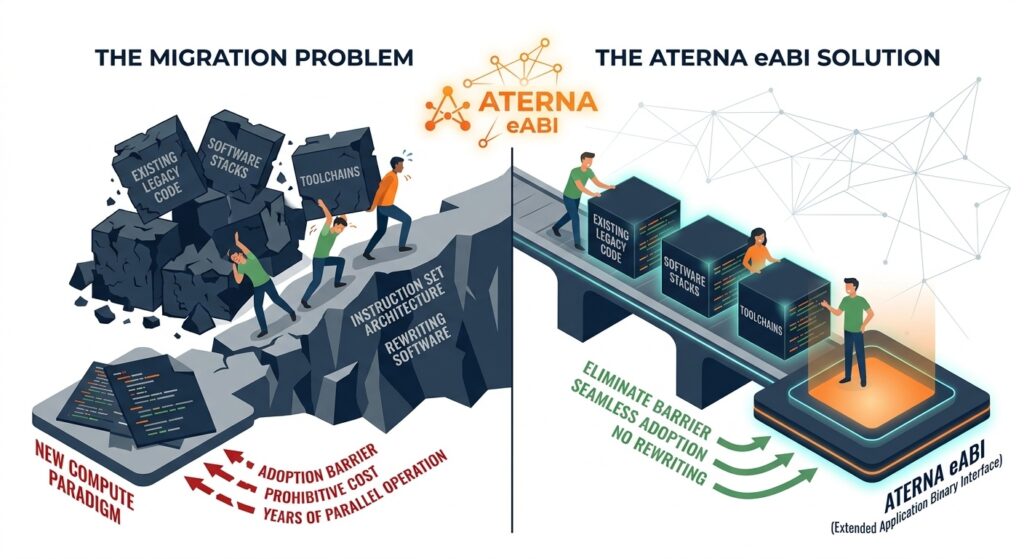
Aterna’s eABI (Extended Application Binary Interface) was designed to eliminate this barrier entirely.

What eABI Does

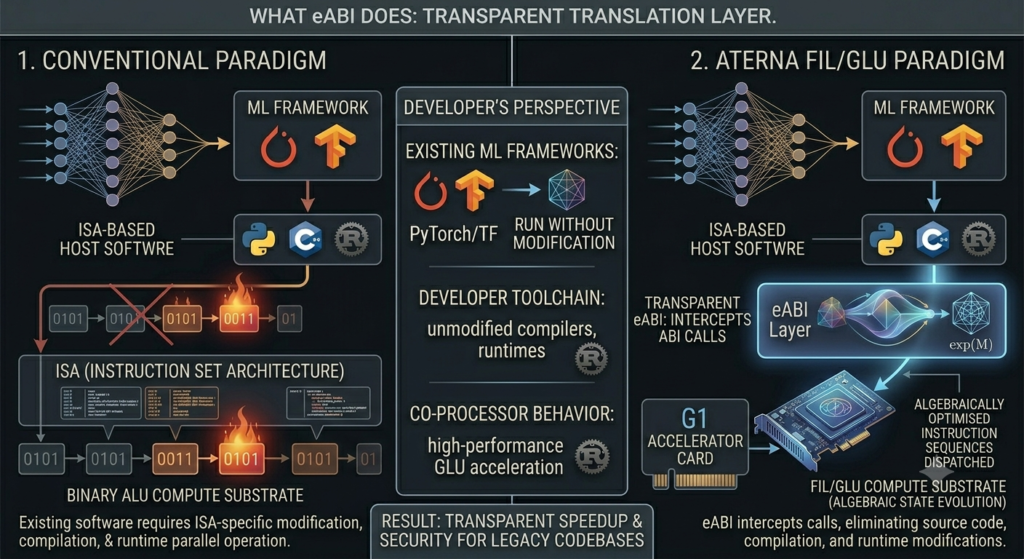
The eABI is a transparent translation layer that sits between host software and the FIL/GLU compute substrate. It intercepts standard ABI calls from Python, C++, and Rust applications and dispatches them to the GLU using algebraically optimised instruction sequences — without any modification to the source code, compilation pipeline, or runtime environment.

From the developer’s perspective, the G1 accelerator card behaves like a high-performance co-processor. Existing ML frameworks, scientific computing libraries, and systems software run without modification. The eABI handles all translation transparently.

Supported Environments

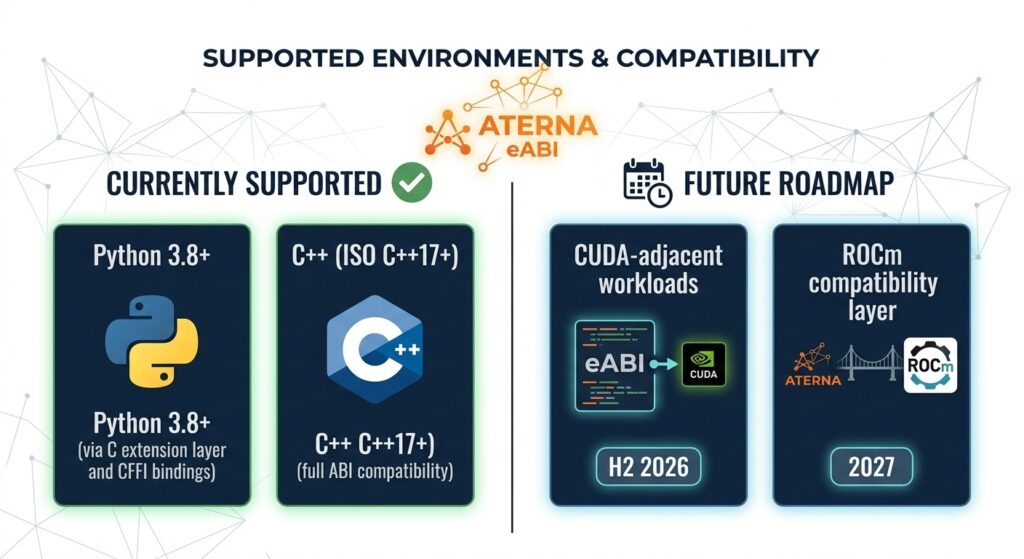
  • Python 3.8+ (via C extension layer and CFFI bindings)
  • C++ (ISO C++17 and later, full ABI compatibility)
  • Rust (stable channel, via FFI and eABI-aware linker flags)
  • CUDA-adjacent workloads via eABI shim layer (roadmap: H2 2026)
  • ROCm compatibility layer (roadmap: 2027)

For Enterprise and Government Customers

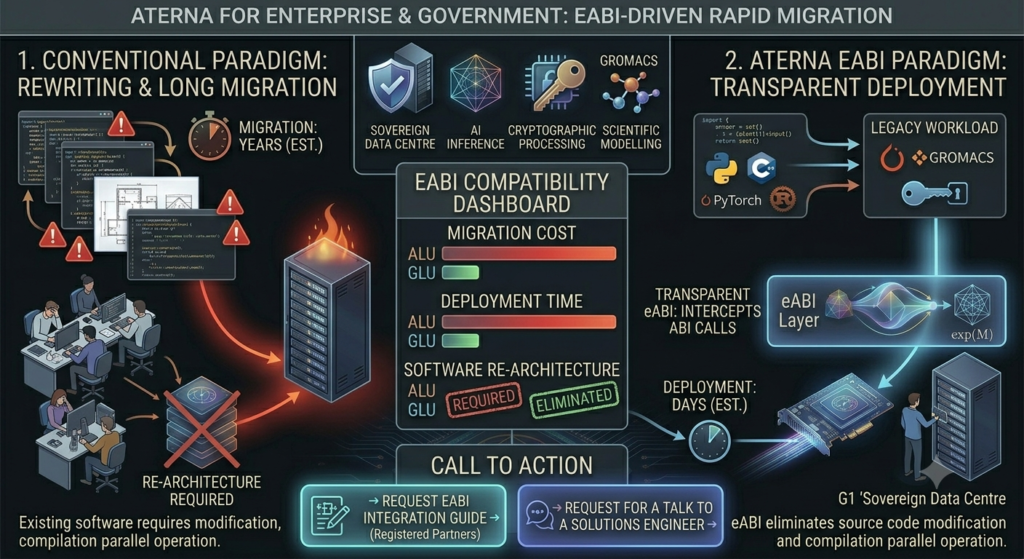
eABI compatibility means that existing sovereign data centre workloads — AI inference pipelines, cryptographic processing, scientific modelling — can be migrated to Aterna hardware without software re-architecture. Deployment is measured in days, not years.

...

Fill out the form to request the document