The GLU Architecture — An Algebraic Compute Engine.

Not an ALU. A Geometric Logic Unit. The difference is fundamental.

What's Wrong With the ALU

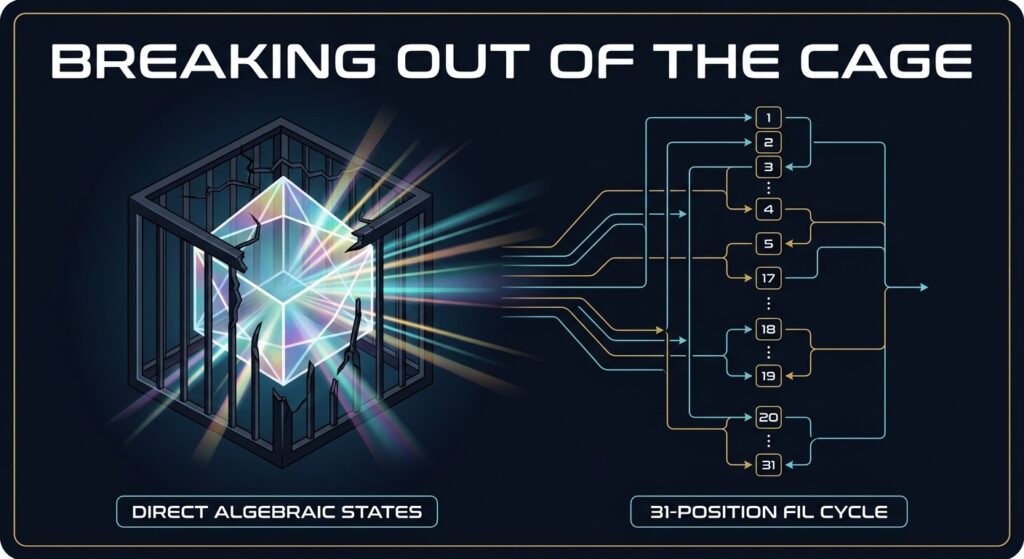
The Arithmetic Logic Unit has been the heart of every processor since the 1940s. It is a masterpiece of engineering optimisation — and a cage built around a 75-year-old mathematical assumption. The ALU performs integer arithmetic and Boolean logic on binary operands. Every modern CPU, from a mobile phone SoC to a data centre accelerator, is built around this structure. The instruction sets change. The transistor count grows. The cage stays the same.

The Geometric Logic Unit

The GLU — Geometric Logic Unit — is Aterna’s algebraic replacement for the ALU. Where the ALU processes binary integers through sequential Boolean operations, the GLU processes algebraic state transitions through Lie group geometry.

In practical terms: a GLU does not add or subtract. It transforms. Inputs enter as algebraic states, traverse the 31-position FIL cycle through geometrically defined transition rules, and emerge as outputs that are algebraically exact and deterministically reproducible. The computational work is performed by the geometry of the algebra, not by switching transistors between voltage levels.

This eliminates the fundamental source of heat generation in binary silicon: the energy cost of switching. GLU transitions are algebraically smooth — not abrupt voltage changes, but continuous geometric transformations implemented in silicon.


Architecture Highlights

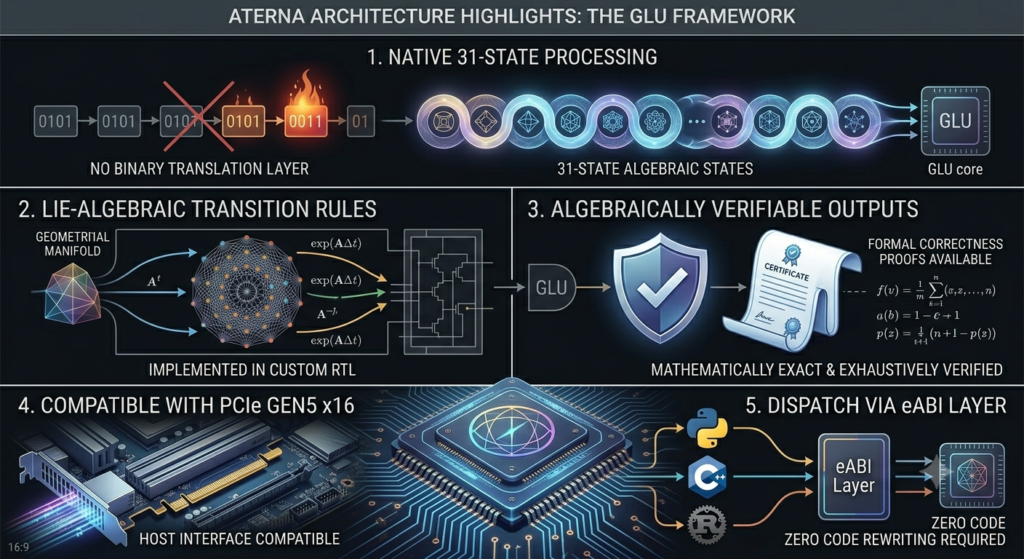
  • Native 31-state processing — no binary translation layer
  • Lie-algebraic transition rules implemented in custom RTL
  • Algebraically verifiable outputs — formal correctness proofs available
  • Compatible with PCIe Gen5 x16 host interface
  • Python, C++, and Rust dispatch via eABI layer — zero code rewriting required

Why This Matters for AI

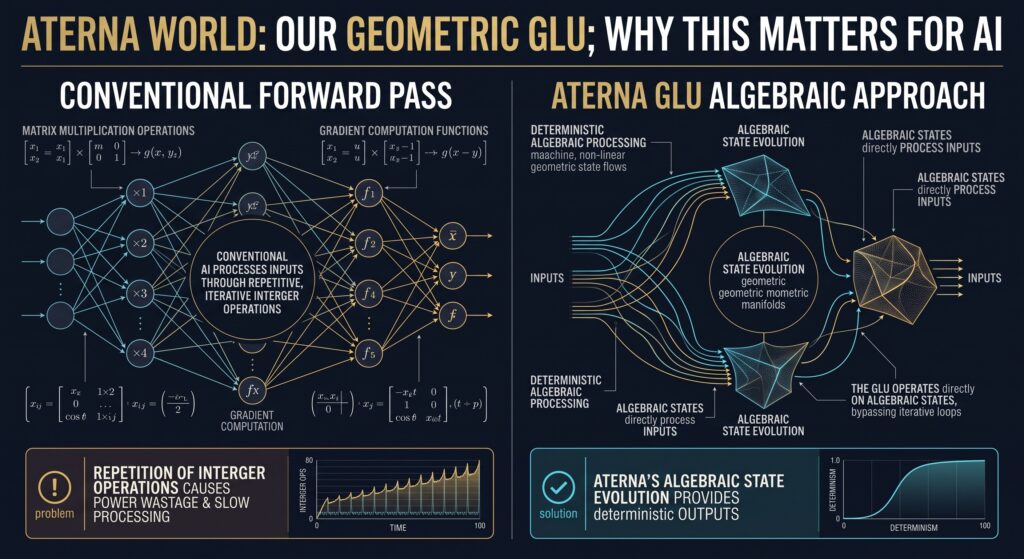
AI inference and training are dominated by matrix multiplication — the mathematical operation underlying every neural network forward pass and gradient computation. Binary ALUs perform matrix multiplication through cascading integer operations. A GLU performs equivalent transformations through algebraic state evolution — fewer transitions, less switching, less heat, lower power, same (or greater) precision.

At scale, across a sovereign data centre running continuous AI inference, this is not a marginal efficiency gain. It is a structural change in the economics of compute.

...

Fill out the form to request the document